Wednesday, November 11, 2009

Project Valour-IT Fundraiser

(This post will remain at the top of the blog until November 12, so scroll down for new posts.) Soldiers'Angels 2009 Valour-IT Fundraiser is going on through November 11. Project Valour-IT helps provide voice-controlled/adaptive laptop computers and other technology to support Soldiers, Sailors, Airmen and Marines recovering from hand wounds and other severe injuries.


Photo Courtesey of Derek, The Packing Rat

If you are a regular reader of the gun blogs you have heard of the annual Gun Blogger Rendezvous in Reno. GBR is also a fund raising benefit for Valour-IT, and in the Packing Rat's photo from GBR-IV we see Major Chuck Ziegenfuss demonstrating a voice activated laptop for the GBR attendees. Valour-IT is one of many Soldiers' Angels projects that benefit wounded American heroes, so please follow the link in this post or on the sidebar, and make a donation.

Thank A Vet Today


God Bless the men and women who serve. 'The Big Parade' still rings true today, even though it was written shortly after the Great War that ended on November 11, 1918.

I wish life could be as simple and as sweet for our heroes as this next song from 1918 depicted the war in France. One of my high school teachers served in an anti-arcraft artillery unit in England during WWII. The personal experience he shared with us about war was his uncle, a WWI vet. The uncle lived with my teacher's family while he was growing up. The uncle's life was a constant struggle to cough up stuff from his lungs, and fighting for breath, because he was gassed while he was in France. Don't forget; thank a veteran!


Tuesday, November 10, 2009

October e-Postal Match Results!

US Citizen has posted the scores of the October contest, and EJ came in with a respectable second place after Mr. Completely in Class 1 pistols! Click Here to go to Traction Control to see the numbers. Be sure you check out these scores; Merle entered fourteen sets of targets, all with very respectable scores.

Decision Time

From the WFIWRADIO website: "The White Squirrel population in Olney is down this year. After a three week census was conducted by volunteers, it was revealed only 111 albino squirrels - a decline of nearly 18%. The number of cats in Olney was up by 11%. Cats are a natural enemy of the town's white squirrel population."

This doesn't look difficult, but don't expect a call to action. The reporter who wrote this will probably be called on the carpet for using the word "enemy."

The United States Marine Corps: 234 Years Today!

Click over to Curtis Lowe's blog to join in the celebration.

Off On Another Adventure

Happy Trails, Little Buddy!

Monday, November 9, 2009

Maybe I Can Get A Grant!


I had the opportunity to help with mopup on a little forest fire last week, just as it was getting dark one evening. This snag was burning, and was leaning into another burning snag. The firefighters on the scene knew that they wanted them down because both trees were very close to their fire line, but were hesitant to start cutting. There was plenty of potential here for a cutter to be hurt, but the process turned out OK, and I think I could sell this as artwork to some museum, judging from some of the modern sculptures I have seen in recent years.

If you are faced with a lodged snag, do not work under it, or try to drop the tree it is leaning against. If you do that, you are the mouse in the trap. The quickest way to take down a tree like this is to make vertical cuts downward, using wedges in the top of the cut to keep the kerf open. Work on the good side of the snag so that if the top comes down it falls away from you, and be poised for a quick exit at the end of every cut. You only have a second or less to be out of the impact zone if a limb drops out of the top when the trunk ka-chunks down. Keep all of the other people on the scene back a safe distance, and remember to re-evaluate the situation and state the plan to yourself before each cut. Dope out snags carefully so that you are on the good side when you turn one loose, whatever type of cut you are using. When the hinge fails, (eventually one will when you cut snags.) you want to be on the good side, and well out your escape route.

Sunday, November 8, 2009

Not My Victrola


Pax41 posted this delightful 1910 recording of 'The Glow-Worm' played by the Vienna Quartet. ( Violin, Flute, Piano, Cello). I think we have an Edison record of this song played on a Xylophone; I will have to do a search for it. When I think of this song I automatically think of Spike Jones and the recording he made during the 1940's. Here is a video posted by Adelfred that shows us the antics that went on during Spike's live performances.

Another Monday, Coming Right Up

Back To The Old Grind!

Snakes Alive!

My opinion of rattlesnakes was colored early in life by western movies and TV shows that always depicted rattlers in a very negative light. I have only run into one rattlesnake while working, and I didn't give it a chance let me know its disposition. A family vacation among rattlers several years ago changed my attitude about rattlesnakes. Every campsite we used for a week was populated by rattlesnakes, and we quickly learned that they would slither away from us if we gave them a chance, and just left them alone. Of course, we always kept the tents zipped shut, and used a light if we had to go out at night.

Ernie Pyle told in his writings that he wasn't afraid of being bitten by a snake; he was afraid of SEEING a snake. Knowing how Ernie felt about snakes, the post he wrote in Chapter VI of "Home Country" must have been a white knuckle experience.

Cactus Country

Rudy Hale and his wife lived alone back of their little store fifty miles east of Yuma, and there was no one else for miles. Three steps from their door and you were ankle deep in bare sand. The Hales caught live rattlesnakes for a living. To me that would be ten thousand times worse than death. But they enjoyed it.

The Arizona sands are filthy with rattlers. Rudy and his wife worked the desert for snakes as a farmer works his land for crops. Rattlers built them a place to live, rattlers kept them in food and clothing, rattlers provided the start for their little gas and grocery business. The loved rattlers.

Rudy was born in Illinois of German parentage, and he still had an accent. He was brought up with the idea of being a surgeon. A relative sent him to school abroad and he studied medicine in Austria for years. When the relative died, his schooling stopped and his life turned.

He wound up in California, where he worked for twenty years as a master mechanic. Then carbon monoxide laid him out and he went to the Arizona desert for his health. It was after two years there that the Hales came right up against it and had to turn to snakes for a living.

They started out by advertising in a San Diego paper. Before they knew it they were swamped with orders. They sold snakes to zoos all over the country, to private collectors, to medical centers for serum, to state reptile farms, to the Mayo brothers. "They say there aren't snakes in Ireland," said Mrs. Hale. "But I know there are, because we've shipped snakes to Ireland."

They didn't even use forked sticks to catch snakes-just picked them up with bare hands and put them in a box slung over the shoulder. They usually hunted snakes for an hour after daylight and an hour before dark. In eight years they had caught approximately twenty thousand rattlers. Rudy had caught as many as fifty sidewinders in one hour's hunting. They had the desert cleaned almost bare of snakes for twenty miles around.

There are twelve species of rattlers in that part of Arizona. The sidewinder is the most deadly, and the Hales specialized in sidewinders. They used to get fifty cents apiece for them. "I just wish I could get fifty cents agian," Rudy said. "They're down to twenty cents now." The most he ever got for a snake was seven dollars; that was a rare Black Mountain rattler. He said the huge snakes didn't bring as much as medium-sized ones. They were harder to keep in captivity, and zoos didn't want them.

Hale had caught rattlers as big around as his leg. He had caught them so big that they'd overpower him and pull his arms together, and he'd have to throw them away from him and then pick them up and try again. "I'm careful not to hurt a snake,' he said. "Any snake I ship is a good healthy snake."

Both Hale and his wife would let rattlers crawl all over them. She even carried them around in her pockets. Neither of them had ever been bitten, but her brother had. He was bitten five times, quick as a flash, by a nest of sidewinders. He didn't say a word-just went and lay down in the sand, flat on his back. stretched out his arms, shut his eyes, and lay there still as death for half an hour. Then he went back to work. Nothing ever happened. The Hales said that most people who died of snakebite really died of fright. Mrs. Hale's brother sat down on a rattler once. One time Rudy himself stepped right into the middle of a huge coiled rattler; his foot slipped and fell down among the coils, but for some reason he wasn't bitten.

There's no danger if you wach your business, Hale said. You mustn't be thinking about anything else when you're picking up a sidewinder. He said the hand was quicker than a snake's strike, and if you missed him the first grab you could jerk back in time. Lots of times when they saw a rattler coiled they would just ease up and slide a hand through the sand under it and lift it up right in the palm of the hand, still coiled.

Rudy had only one sidewinder on hand the day I was there. It was in a roofless concrete tank behind the house. He took me out for a look after dark and turned on a dim little electric light. He took a stick with a nail in it and got the sidewinder hooked over the nail, and had it lifted almost to the top of the tank. Just then his little red dog stuck it cold nose up my pants leg. I let out a yell and landed somewhere way over the other side of Gila Bend, and never did go back after the car."

Excerpt from "Home Country" by Ernie Pyle, William Sloane Associates, Inc., New York, 1947

Saturday, November 7, 2009

It's Here, and Ignoring It Won't Make It Go Away

"A disgruntled Muslim soldier murdered his officers way back in 2003, in Kuwait, on the eve of Operation Iraqi Freedom. Recently? An American mullah shoots it out with the feds in Detroit. A Muslim fanatic attacks an Arkansas recruiting station. A Muslim media owner, after playing the peace card, beheads his wife. A Muslim father runs over his daughter because she's becoming too Westernized.

Muslim terrorist wannabes are busted again and again. And we're assured that Islam's a religion of peace." Read the entire article by Ralph Peters over on Major Chuck Z's blog.

Weekend Steam

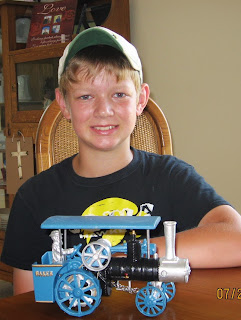
This Harrison Jumbo engine at Pinckneyville is only the third traction engine of this model that I have seen. One is at Old Threshers at Mt. Pleasant, and the second one was on a side road off of US Highway 63 between Columbia and Jeff City, Missouri. The Jumbo and a Frick engine were occupying an abandoned home site, and were both quietly oxidizing in the early 1970's when I was going to college at Mizzou. By the time I graduated both engines had disappeared, I hope to an engine fancier and not a scrapper.


The tall side mounted rear wheels give this engine a distinctive appearance, and the front mounted water tank really sets it off from the crowd at an engine show.

Friday, November 6, 2009

Crankin' It Up


The change to Dark Time is taking some effort for me this year; I can't seem to be able to reset my body clock. That got me to thinking about Harry Lauder and "It's Nice To Get Up In The Morning," so we are doing a re-post of this great song. Good Nicht!

Thursday, November 5, 2009

Range Buddies

I went out behind the barn to pop some caps a few days ago, but the range was already occupied. Oh Well, I took the guns back to the house and sat out front to enjoy the view. Everybody won.

Tuesday, November 3, 2009

Prime and Start


One of the accessories you will see on old gas engines is the priming cup. It is a little brass petcock with a cup on the top, which is screwed into a port on the combustion chamber with a tapered pipe thread. Before cranking, you open it with the lever on the side, and squirt or pour a little gasoline into the cup to charge the cylinder. You will see the operator perform the routine in this brief video.